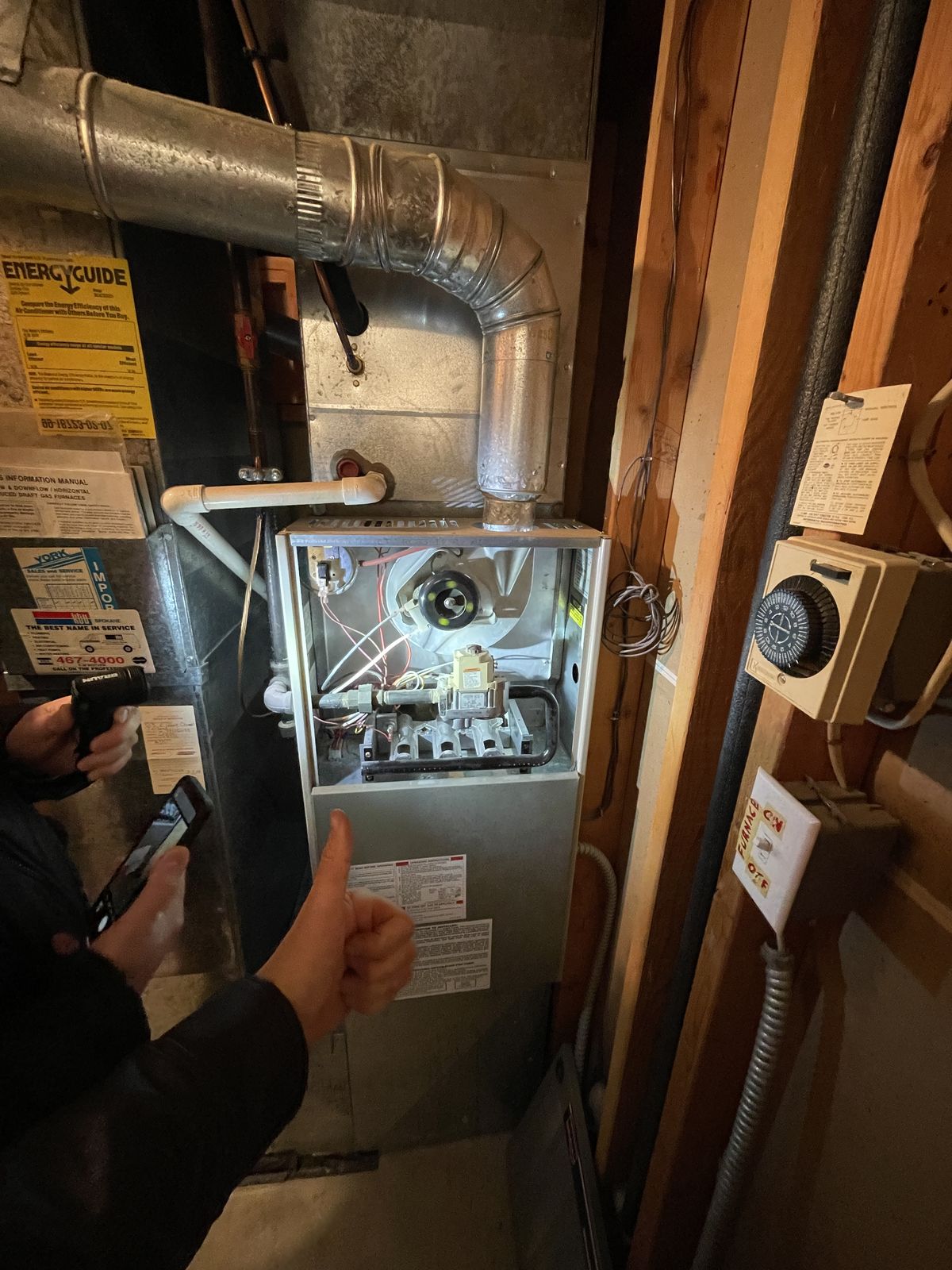
Somewhere around a furnace's fifteenth birthday, every repair invoice starts carrying a silent second question. Here's the framework we actually use when a homeowner in a Lynnwood basement asks it out loud — including the parts a replacement-hungry industry tends to skip.
The multiplication shortcut
The old field rule holds up: age × repair cost. If the furnace's age in years times the repair quote crosses roughly 5,000, replacement deserves a real look; below it, repair usually wins. A modest repair on a 10-year-old furnace stays well under that line: fix it without ceremony. A major repair on a 19-year-old furnace sails past it: now we're talking. It's a shortcut, not scripture — but it kills both bad instincts: dumping money into a dying unit, and scrapping a healthy one over a capacitor.
The one component that decides alone
A cracked heat exchanger ends the debate — it's the wall between combustion gases and your household air, it isn't economically repairable, and on most aging furnaces its replacement cost approaches a new unit's. It's also, frankly, the most abused diagnosis in the industry, used to stampede homeowners. If anyone (again, including us) condemns your heat exchanger, you're entitled to see the evidence — camera images of the crack, or a combustion analyzer reading — before signing anything. A real crack: replace the furnace. A claimed crack without evidence: get a second opinion; we provide them regularly.
Efficiency math, without the brochure gloss
Jumping from an old 80% furnace to a 95%+ condensing unit saves a real double-digit percentage of gas — meaningful over a Puget Sound heating season, though rarely enough alone to justify early retirement of a healthy unit. Jumping from 92% to 96% saves comparatively little; don't let that delta be the closing argument for anything.
The fork in the road: don't auto-replace like-for-like
The day a furnace truly dies is the cheapest day to reconsider the whole system — because in our mild marine climate, a heat pump (alone, or dual-fuel with a smaller furnace as backup) frequently beats a straight furnace swap on operating cost while adding the summer cooling this region now clearly needs. We wrote a full comparison; the short version is that the answer depends on your fuel, ducts and bills, and it deserves both quotes side by side.
What you should get either way
A repair quote with the age-math acknowledged out loud, a replacement quote (or two — furnace and heat pump) with real load sizing rather than a sticker copy, and zero pressure to decide during the no-heat panic: a space heater and a day of thinking cost nothing against a 15-year decision. That's the standard we hold ourselves to in your basement.