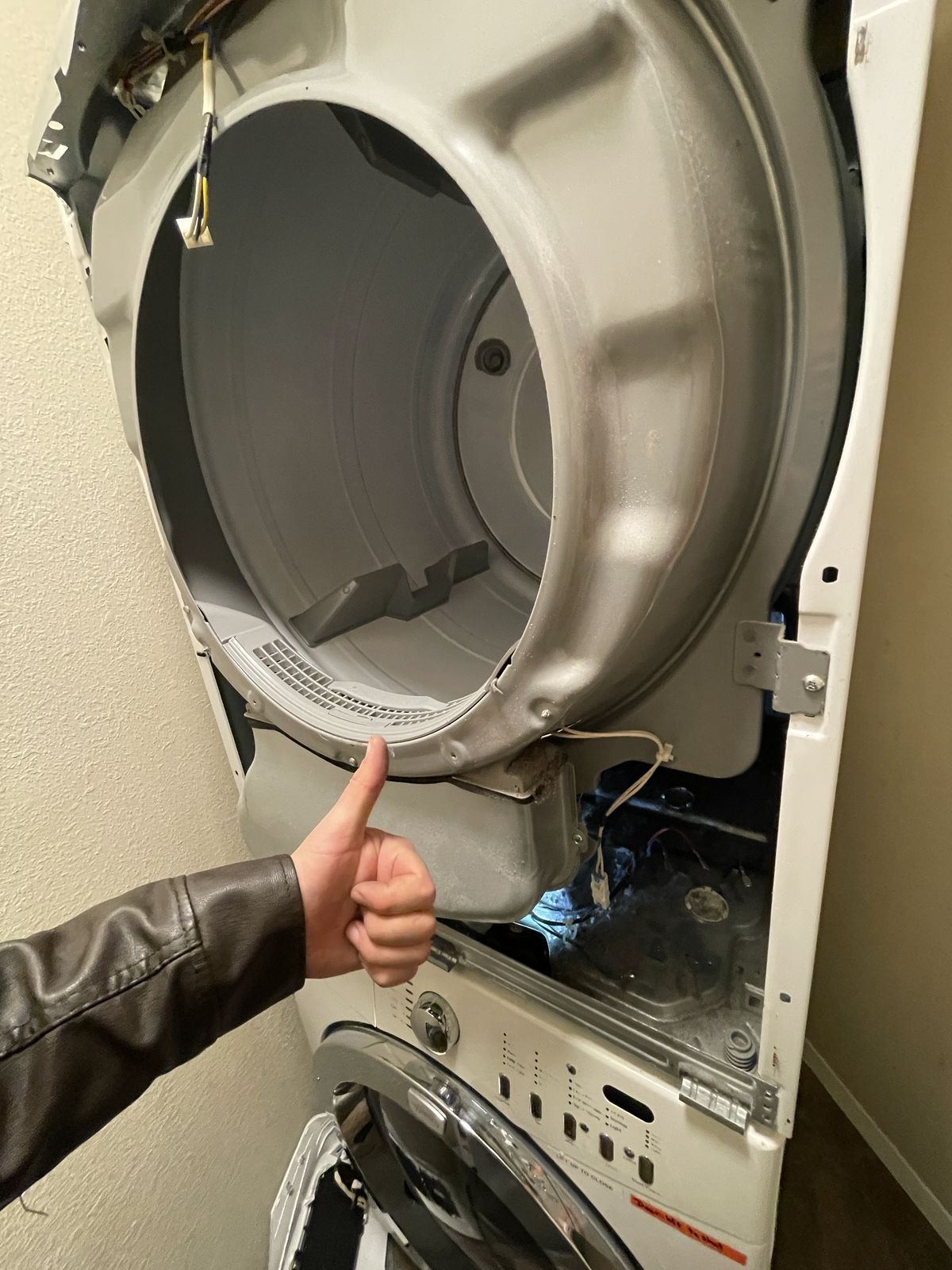
"It still works, it just takes forever" is how this call always starts. A Maytag that needs two cycles for a load of towels is wasting your time and your electricity, and the counterintuitive truth from hundreds of these visits: the heater is almost never weak. Heating elements are binary — they work or they don't. Slow drying is an airflow story, with a sensor subplot.
Airflow: where the heat actually goes
A dryer doesn't dry with heat; it dries by moving hot, moist air out. Restrict the exit and the drum turns into a sauna — clothes get hot and stay wet. The restriction hides in three places: the lint screen (film builds up even on clean-looking screens — if water pools on it instead of running through, wash it with soap), the internal duct below the screen, and above all the vent run to the outside.
Our region makes this worse. Marine-damp air keeps lint tacky, so it plasters onto duct walls instead of blowing clear — and the long vent runs in Lynnwood and Mill Creek homes, where laundry closets sit far from an exterior wall, give it plenty of surface to colonize. The test we do at every slow-dry call: measure airflow at the exterior vent flap. Strong flow that flaps the damper hard is healthy; a limp breeze means the duct is the patient.
The moisture sensor subplot
Sensor-dry Maytags decide for themselves when clothes are done, using two metal bars inside the drum. Years of dryer sheets coat those bars with a waxy film, and the sensor starts hallucinating — sometimes shutting off early (clothes damp), sometimes running long because it can't get a clean reading. The fix costs nothing: wipe the bars with rubbing alcohol. We tell every sensor-dry owner this trick, ideally before they need us.
The load-size honesty check
Maytag's large-capacity drums invite oversized loads, and a drum packed tight can't tumble air through the middle of the wad. If a normal load dries fine and only the mega-loads crawl, the machine is telling you its physics, not failing.
When a part really is to blame
A partially blocked blower wheel (lint mat or a stray sock), a cycling thermostat cutting heat too early, or on gas models a weak gas valve coil that drops the flame intermittently — these all cause truly slow drying and all show up in a proper diagnosis. So does a crushed foil transition hose behind the dryer, the cheap little villain of many a two-cycle complaint.
The payoff
Slow-dry repairs are the most satisfying kind: fix the airflow and the same Maytag that needed 110 minutes suddenly finishes towels in 45, runs cooler, and stops feeding its thermal fuse to the vent gods. A written quote after we measure, and you'll see the airflow numbers before and after.