Dryer
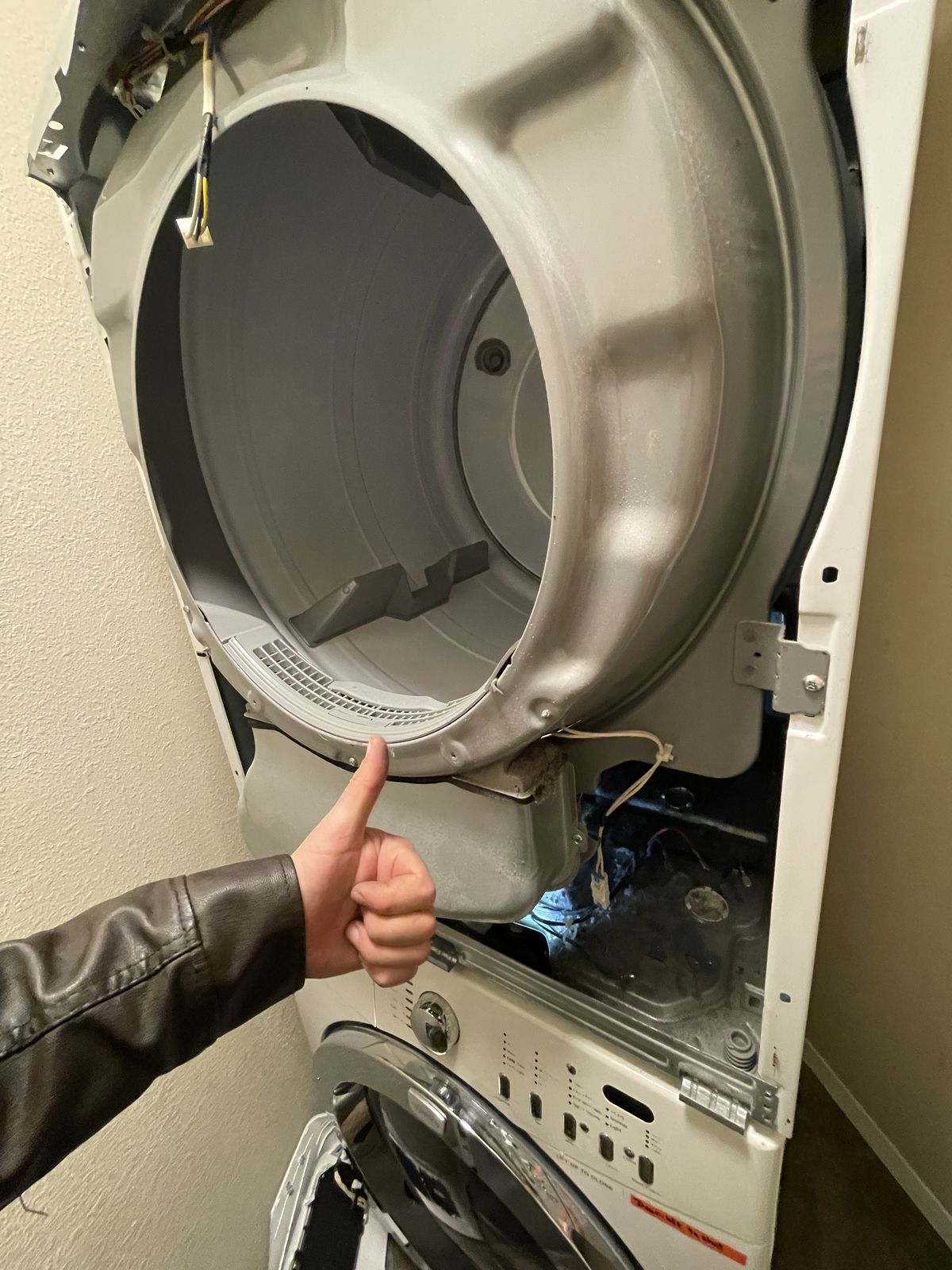
GE Dryer Grinding or Drum Not Turning? Meet the Rear Bearing GE Built Differently
GE dryers hang the drum on a rear bearing and front slides, unlike roller-based brands. What the grinding means, the bearing kit fix, and belt checks on GE.
 Formerly Adam & Sam Brothers Repair
Woodinville · valley, hills and downtown
Laundry in Woodinville runs big: muddy trail gear, dog bedding, barn coats and full family loads in large-capacity steam dryers. We repair those machines, gas or electric, about 18 to 23 minutes from our shop by I-405 and SR 522.
Woodinville is really two places sharing a name. Downtown, along SR 522 and near the old 1936 schoolhouse, large apartment complexes now hold about a quarter of the city's homes, most fitted with stacked or compact laundry. Out across the Sammamish River and up into the hills toward NE 175th Street and the Woodinville–Duvall Road, newer houses sit on bigger lots, many built after 2000, with mudrooms, three-car garages and full-size laundry rooms. The valley floor in between still holds farmland, riverside trails and the tasting rooms of wine country, along with Hollywood Farm, dating from 1910.
What ties those homes together for us is load size. Newer large-capacity dryers, many with steam cycles, Wi-Fi apps and moisture sensors, get asked to dry soaked rain shells, dog beds, horse blankets and a week of soccer uniforms in one go. They report their own faults through codes and app alerts, so the problems we see here tilt toward sensors and boards. The mechanical side matters just as much, though: heavy wet loads work belts, rollers and drum bearings harder than any spec sheet assumes.
A mudroom laundry gets the hard stuff. Trail dirt, arena sand, pet hair and the odd wood chip ride in on clothing, and enough of it reaches the lint screen to wear holes in the mesh. Once the screen is torn, grit passes into the blower wheel and duct, the wheel goes out of balance and lint packs against the debris. Heavy horse blankets and dog beds add another load: they pin the drum against its rollers and rear bearing, and those parts wear out years early. When we open one of these dryers we clean the blower housing, replace whatever is worn, and suggest checking the lint screen for tears after any muddy load. A replacement screen costs little; a blower wheel thrown off balance by gravel does not.
Weather plays its part. On April 18, 2008, a Convergence Zone snow band dropped 6.5 inches on Woodinville, and when snow piles against a low wall hood the flap can freeze shut. Hillside homes often send the exhaust out at ground level on the uphill side, where leaves and snowmelt collect. A dryer that suddenly takes twice as long after a cold snap usually has a blocked hood, not a broken heater. We clear it, then check that the duct behind it hasn't filled with damp lint.
Downtown, the large complexes add a different job: compact or stacked dryers on long concealed ducts. We clean what we can reach from the unit, measure exhaust and put in writing anything the building side must handle. PSE is the utility for power and gas alike in Woodinville, with heating split close to evenly between the two, so we come prepared for either kind of dryer. Getting to you is a matter of I-405 to the SR 522 exit and a few miles east; toward Hollywood Hill or the Woodinville–Duvall Road, add a few minutes. Gas dryer owners should know the one rule we repeat everywhere: a gas smell means everyone leaves the house first, and the call to 911 or to PSE (1-888-225-5773) is made from outside.

Woodinville dryer repair starts at $235. Rollers, idler and belt on a large-capacity drum, control boards, and tripped thermal fuses or tired thermostats are what we replace most here. That number is a beginning point in the area we serve, not a quote. The $85 diagnostic decides what your particular dryer needs, the price arrives in writing before work starts, and approving the repair means the diagnostic is no longer billed by itself.
Starting prices for the north Seattle area, 2026. The $85 diagnostic is included in any repair you approve, and the exact price is in the written estimate before work starts.
Usually, yes. A large-capacity steam or smart dryer cost a fair amount new, and most of what fails on it, belts, rollers, a fuse, a water valve or a sensor, is an inexpensive part, so the repair stays well under the cost of a replacement. Boards are the exception worth thinking about. If a main board fails on a dryer well into its second decade, and the drum bearing or motor is also tired, the repair can start approaching the price of a new machine, and we'll lay those numbers out side by side. One more thing to weigh in Woodinville: heavy-duty use. A household that regularly dries horse blankets or dog beds should expect rollers and bearings to wear faster no matter which dryer it owns, so the choice of a newer model alone won't fix that. Repair what's worn, keep the lint screen intact and the vent clear, and a well-built dryer handles this work for years. If you do replace, measure the laundry doorway and the hallway turn before you shop; the newest large drums are wider and deeper than older models.
Yes. Steam dryers add a water valve, a nozzle and a supply hose to the usual parts, and connected dryers add app alerts and more sensors. We test those components the same careful way as heaters and belts, and many of the parts ride on the van. Telling us the error code or app alert when you call or book helps us prepare.
Not necessarily. Very heavy, wet items take longer and strain the drum supports, and some dryers stop early when sensor bars get confused by bulky loads. If drying has gotten slower for everything, though, something has changed, often the vent or a worn roller. We measure airflow and inspect the drum supports to tell which.
We do. Valley, hillside and downtown addresses are all part of our regular area, typically 18 to 23 minutes off-peak from our shop, a bit more toward the far east side. Call before midday and we can often be there the same day, Monday through Saturday, with no added charge for distance.
Yes, especially a hood mounted low on the wall. Snow and ice can freeze the flap shut, and the dryer then overheats or takes much longer. Keep an eye on low hoods after a snowfall. If drying slows sharply after a cold snap, call us and we'll clear the hood and check the duct behind it.
Yes. We repair stacked and compact dryers in the downtown complexes, including pulling a unit out of its closet when the repair calls for it. Mention building access and parking when booking. If the restriction sits in a shared duct we can't reach, we'll tell you exactly where it is so management can address it.
Talk to Adam & Sam
Book online for up to $18 off the repair, or call (425) 570-9520 and read us the error code. The $85 diagnostic is included when you approve the repair, valley or hillside.
Dryer
GE dryers hang the drum on a rear bearing and front slides, unlike roller-based brands. What the grinding means, the bearing kit fix, and belt checks on GE.
Dryer
GE electric dryers use open-coil heating elements that break with age, backed by safety thermostats that trip from vent restriction. Our GE diagnosis order.
Dryer
A dead GE dryer is usually power, the door switch or the belt, rarely the board. Our five-minute elimination checklist for GE dryers that won't start.
Schedule a repair
Send the basics and we call you back with an arrival window, most days the same morning.